
How to Solve NYT Sudoku Hard: Step-by-Step Guide (Without Guessing)
The New York Times Hard Sudoku is the daily proving ground for hundreds of thousands of solvers worldwide. With only 22 to 26 starting clues, basic crosshatching exhausts its utility within the opening minutes. If you find yourself stuck on today's NYT Hard Sudoku, wondering whether the puzzle demands trial-and-error, or perplexed by cryptic yellow hint highlights, this tactical guide deconstructs the exact deduction framework required to solve daily boards cleanly and deterministically.
Table of Contents ▼
Board Anatomy & Realistic Solving Benchmarks
Unlike casual puzzle apps that generate boards with unbalanced clue clusters, the New York Times puzzles follow disciplined mathematical constraints. Each Hard board is generated with between 22 and 26 givens, distributed to prevent straightforward single-digit sweeps.
Rapid dual notation + immediate locked candidate recognition
Methodical candidate marking + spot-checking pointing pairs
Re-scanning bottlenecks + resolving multiple dead ends
Categorically, no. Every authentic NYT Sudoku puzzle is mathematically verified to possess exactly one unique solution. Guessing (bifurcation) is never necessary. When a solver hits an apparent wall, it invariably indicates an overlooked logical constraint—such as a Pointing Pair, Box-Line Claiming, a Hidden Triple, or an unspotted Naked Pair.
Platform Architecture: NYT Hard vs. NetSudoku
Comparing the digital interface and solving toolsets between The New York Times and dedicated logic platforms highlights distinct architectural approaches:
| Dimension | The New York Times (Hard) | NetSudoku.com |
|---|---|---|
| Difficulty Tiers | 3 fixed tiers (Easy, Medium, Hard) | 5 granular tiers (Easy, Medium, Hard, Expert, Evil) |
| Hint Transparency | Yellow target cell highlight (technique unspecified) | Pedagogical logic hints (names technique + visual elimination lines) |
| Past Puzzle Archives | Requires paid NYT Games subscription (free web is current day only) | Unlimited permanent archives accessible on demand |
| Timer Activation | Waits for initial click or keyboard interaction | First-move activation (zero pressure until you begin solving) |
| Candidate Housekeeping | Manual toggle or full automated clutter | Dual pencil modes with real-time auto-pruning |
| Dark Mode | Standard light theme on web; app varies | High-contrast OLED Dark Mode supported natively |
The 3-Phase Solving Playbook for NYT Hard
Attempting to fill in full candidate notation across all 81 cells immediately leads to visual fatigue and cognitive overload. Top solvers divide the solving routine into three distinct phases:
Phase 1: The Opening Sweep (Minutes 0 – 4)
Crosshatching & Snyder PairsSystematically cycle through digits 1 through 9. Crosshatch rows and columns to resolve obvious Naked Singles and near-complete houses (rows, columns, or boxes missing only 1 or 2 digits). During this sweep, pencil in candidate marks strictly when a digit is confined to exactly two cells within a house.
Phase 2: Breaking the Bottleneck (Minutes 4 – 12)
Locked Candidates & TriplesWhen direct placements stall, look for Pointing Pairs, Pointing Triples, and Box-Line Claiming interactions. If dual notation does not break the deadlock, inspect crowded houses (rows or boxes with 5–6 filled cells) for Hidden Pairs and Triples. Uncovering a single locked candidate set often triggers an immediate cascade of confirmed digits.
Phase 3: Endgame Resolution (Minutes 12+)
Singles CollapseOnce the primary structural bottleneck is cracked, the remaining 20 to 25 cells typically collapse into alternating singles. Conduct a final pass, confirm house totals with the 45-rule if needed, and finalize the grid.
Snyder Notation: Box & Line Principles
Pioneered by World Sudoku Champion Thomas Snyder, Snyder Notation is an essential methodology for maintaining an uncluttered grid while ensuring no dual-candidate relationships are overlooked:
Core Rules of Snyder Marking:
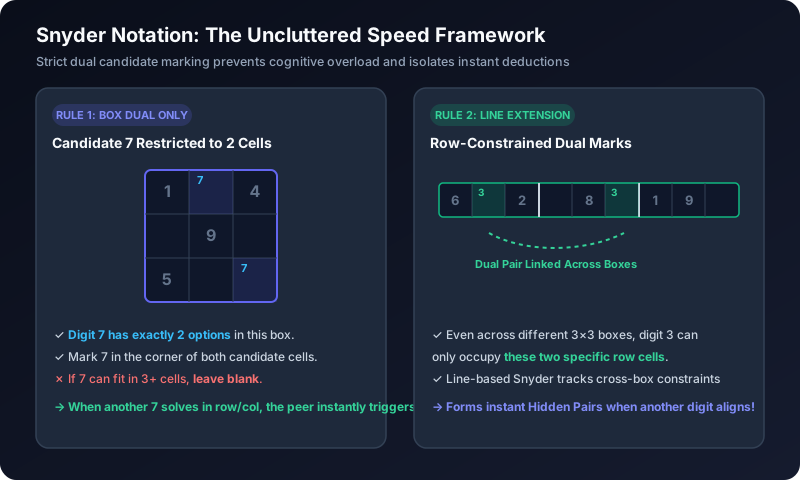
- Box-Based Snyder: In any 3×3 box, if an unplaced digit can only fit into exactly two cells, pencil that digit into both cells. If it can fit into three or more cells, write nothing.
- Line-Based Snyder (Rows & Columns): When scanning rows and columns, if a candidate digit is restricted to exactly two cells along that line, record that dual relationship—even if the cells cross different 3×3 boxes. This exposes cross-box pairs that standard box scanning misses.
- Instant Naked Pairs: If two cells within the same house share the exact same two Snyder candidate marks, those two digits are locked to those cells, forming an instant Naked Pair.
When to Expand: While Snyder notation handles the opening phase efficiently, challenging NYT Hard boards cannot always be solved with dual markings alone. When Snyder pairs fail to yield progress, expand your pencil marks within the most constrained houses to evaluate potential triples and quads.
Pointing Pairs & Box-Line Reductions: Breaking the Bottleneck
On NYT Hard, the puzzle author frequently anchors the board's central difficulty on a Locked Candidate interaction between a 3×3 box and an intersecting line:
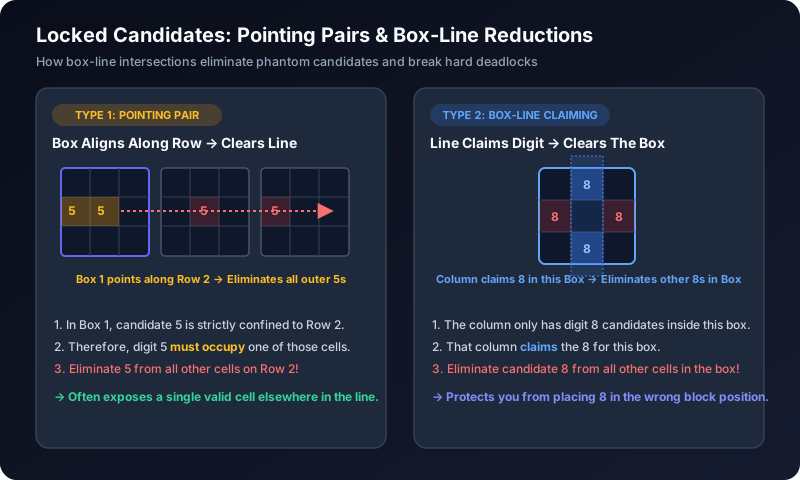
1. Pointing Pairs & Triples (Locked Candidates Type 1)
Examine a 3×3 box. If candidate notes for digit 5 appear in only two or three cells, and all of those cells lie on the same row, that digit 5 must be placed within that box along that row. Consequently, digit 5 cannot exist in any other cell along that row outside the box. Eliminating those candidates frequently uncovers a Naked Single in an adjacent box along the line.
2. Box-Line Reduction / Claiming (Locked Candidates Type 2)
The inverse mechanic: examine an entire row or column. If candidate notes for digit 8 appear exclusively within a single 3×3 box, that line "claims" the 8 within that box. Consequently, digit 8 cannot exist in any other cell inside that 3×3 box. Pruning these phantom candidates often unlocks hidden singles or pairs inside the box.
Advanced Patterns: X-Wings & Unique Rectangles
When standard locked sets are insufficient, NYT Hard puzzles occasionally rely on multi-line fish logic or uniqueness deductions:
The X-Wing Candidate Elimination
An X-Wing occurs when a digit can only appear in two cells in row A and two cells in row B, and those candidate cells align in the exact same two columns (forming a rectangle). Because the digit must occupy opposing diagonal corners, that digit can be eliminated from all other cells in those two columns.
Read our complete X-Wing visual tutorial →Unique Rectangle (UR Type 1)
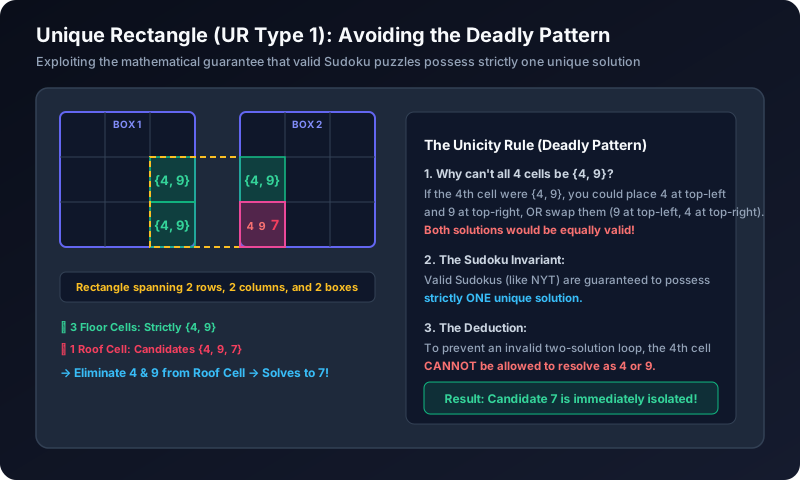
A standard Unique Rectangle Type 1 involves 4 cells spanning exactly two rows, two columns, and two 3×3 boxes. If three cells contain strictly the candidate pair {A, B} (the floor cells) and the fourth cell contains {A, B, X} (where X represents one or more additional candidate digits), candidates A and B can be safely eliminated from that fourth cell.
Why it works: If the fourth cell were allowed to resolve as {A, B}, the puzzle would contain a "deadly pattern" allowing digits A and B to swap corners, producing two equally valid solutions. Since authentic Sudoku puzzles are guaranteed to have a unique solution, the deadly pattern is impossible—forcing candidate X as the only viable option.
Video Study Guide & Master Walkthrough Analysis
Observing competitive solvers tackle difficult daily boards provides valuable insight into visual scanning cadence and disciplined candidate management. When studying video walkthroughs (such as daily breakdowns by channels like Cracking The Cryptic or dedicated NYT speed solvers), focus on these core analytical milestones:
What to Look for in Daily NYT Walkthroughs:
- The Opening Cadence (First 3 Minutes): Notice how experienced solvers do not mark every possibility. They sweep numbers 1 through 9 sequentially, only placing confirmed digits and strictly recording dual Snyder pairs in boxes.
- Recognizing the Chute Bottleneck (Minutes 4 – 8): When simple scanning yields nothing, observe how the solver switches attention to parallel chutes (groups of three 3×3 boxes). They look for pointing pairs that eliminate candidates in neighboring blocks.
- Candidate Hygiene (Minutes 8 – 12): Pay close attention to how quickly they clean up stale pencil marks immediately after committing a confirmed digit. Neglecting candidate hygiene is the primary reason amateur solvers miss breakthroughs.
- Endgame Collapse (Final Minutes): Observe how the puzzle transitions from a rigid deadlock into a cascade of single-candidate resolutions once the key constraint is removed.
Demystifying the Cryptic Yellow Hint Cell
If you have ever clicked the "Hint" button on NYT Sudoku, you were likely presented with a single cell highlighted in bright yellow—with no accompanying explanation. Solvers frequently ask: what do the hints mean in NYT Sudoku?
How the NYT Hint Engine Operates:
The NYT hint engine evaluates the current state of the board against an internal solver dependency tree. When you request assistance, it highlights the cell that is theoretically next in line to be solved logically.
Why It Confuses Solvers: The highlighted yellow cell is often not an immediate naked single. Instead, it is frequently a cell that resolves only after you spot a secondary locked constraint (such as a Pointing Pair or Box-Line Claiming set) elsewhere in its intersecting row, column, or box. Because the interface does not name the rule or highlight the conflicting lines, solvers are often left guessing why that cell was highlighted.
Frequently Asked Questions (FAQ)
Does the NYT Hard Sudoku ever require guessing?
No. Every official NYT board is guaranteed to have a singular unique solution reachable entirely through deductive elimination. If you find yourself bifurcating (guessing between candidates), an interlocking constraint like a locked candidate set or hidden pair has been overlooked.
How long should NYT Hard Sudoku take on average?
Experienced solvers typically finish in 5 to 15 minutes, intermediate solvers average 15 to 35 minutes, while casual solvers take 35 to 60 minutes.
What is Snyder Notation and how does it apply to NYT Hard?
Snyder Notation is a disciplined pencil-marking method where you only write candidates if a digit is restricted to exactly two cells in a house (primarily boxes, extended to rows and columns). It keeps your board clean and exposes pointing pairs immediately.
Do NYT Hard Sudoku puzzles require advanced patterns like X-Wings?
Yes, on select daily boards. While many NYT Hard puzzles resolve through pointing pairs, box-line reductions, and pairs, tougher boards regularly feature hidden triples, naked quads, and occasionally X-Wings or Unique Rectangles.
What does the yellow cell highlight mean when using a hint on NYT Hard?
The yellow cell marks the next cell in the solver dependency graph that can be logically solved. However, because NYT doesn't explain what technique to apply, solvers are often still perplexed by the required intermediate deductions.
How many clues are given in an NYT Hard Sudoku?
NYT Hard puzzles have between 22 and 26 starting clues (givens). NYT Medium gives 28–32, and NYT Easy gives 36–40.
Ready to Practice Hard Sudoku with Pedagogical Hints?
Experience distraction-free Sudoku with educational logic hints, OLED dark mode, and endless technique-graded boards.