
How to Play Sudoku: The Complete Step-by-Step Beginner’s Guide
NetSudoku Editorial Team
Reading time: 7 min · Illustrated with 4 Interactive Visual Diagrams
Table of Contents ▼

If you have ever stared at a 9×9 grid filled with numbers and assumed it required high school algebra or mental arithmetic, you are not alone. It is the single most common misconception about Sudoku.
Here is the truth: Sudoku requires absolutely zero math. You will never add, subtract, multiply, or divide a single digit. The digits 1 through 9 are simply symbols—markers in an elegant game of spatial pattern recognition and deductive elimination. If the board used nine distinct fruit emojis or Greek letters instead of numbers, the puzzle would remain identical.
Whether you arrived here from search after browsing guides on Sudoku Bliss, 247 Sudoku, Conceptis, or Kristanix, this comprehensive guide synthesizes everything you need to know. Below, we break down the game from the ground up, starting with a rapid 30-second summary, followed by a step-by-step visual tutorial and battle-tested solving strategies.
Sudoku at a Glance: The 30-Second Rulebook
In a hurry? Here are the core rules of Sudoku boiled down to their simplest possible essence:
Fill the entire 9×9 grid so every single row, column, and 3×3 box contains all numbers from 1 to 9.
No number can repeat within the same horizontal row, vertical column, or 3×3 subgrid square.
Scan for rows or boxes that are mostly full. Use elimination to fill the missing spots. Zero guessing required!
Step 1: Understand the Board Layout
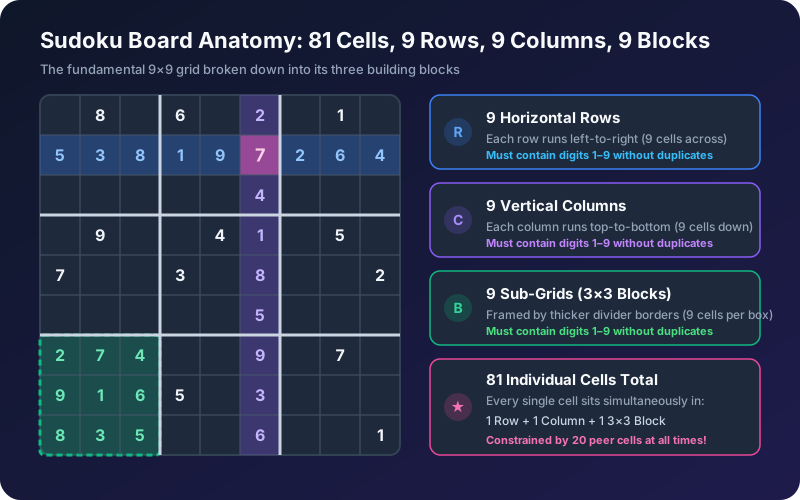
Before making a single move, take a moment to look at the anatomy of the puzzle. A standard classic Sudoku board consists of 81 individual cells arranged into a square matrix:
- 9 Horizontal Rows: Running across the board from left to right. Each row contains 9 cells.
- 9 Vertical Columns: Running down the board from top to bottom. Each column contains 9 cells.
- 9 Sub-Grids (3×3 Blocks / Nonets): The board is demarcated by thick, darker divider lines that group the cells into nine distinct 3×3 square regions.
When you start a new game, several cells are already pre-filled with numbers. These are called "givens" or "clues." Your objective is to fill the remaining empty spaces using logic.
💡 The Power of the Intersection:
Notice that every single cell on the board belongs to three zones at the same time: exactly one row, one column, and one 3×3 block. This means any number you place in a cell is constrained by 20 companion cells (8 in its row + 8 in its column + 4 remaining in its box).
Step 2: The Three Non-Negotiable Rules
Sudoku has one of the simplest rulebooks in all of gaming. You only need to memorize three non-negotiable constraints:
Rule 1: Each Horizontal Row must contain digits 1–9 without repeats
In every one of the 9 horizontal rows, each digit from 1 to 9 must appear exactly once. You cannot have two 4s or two 7s in the same row.
Rule 2: Each Vertical Column must contain digits 1–9 without repeats
In every one of the 9 vertical columns, all nine digits from 1 through 9 must appear exactly once. Duplicate digits in any vertical column constitute an invalid move.
Rule 3: Each 3×3 Sub-Grid Block must contain digits 1–9 without repeats
In each of the nine demarcated 3×3 square blocks, all digits 1 to 9 must be present. No digit can be duplicated inside the same box.
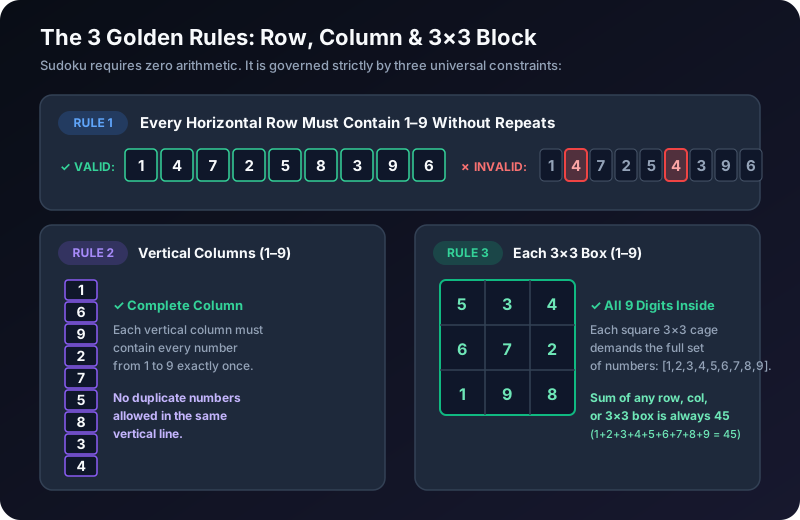
45 (1 + 2 + 3 + 4 + 5 + 6 + 7 + 8 + 9 = 45). Expert paper solvers frequently use this arithmetic check to verify completed houses!
Step 3: Basic Strategies to Actually Solve Puzzles
Knowing the rules is easy; knowing where to place your very first digit is where most beginners freeze. Here is the four-part methodology used by master solvers to unlock any board:
Strategy 1: Scan for "Low-Hanging Fruit"
Do not begin by looking at empty, barren corners of the board. Instead, scan for rows, columns, or 3×3 blocks that are already mostly filled (having 5, 6, or 7 givens).
If a row already has [1, 2, 4, 5, 6, 8, 9], you only have two numbers left to place: 3 and 7. Instead of choosing between nine possibilities, you only have to check whether an intersecting column or block already contains a 3 or 7. Finding 2 missing numbers is ten times easier than finding six!
Strategy 2: The Crosshatching (Scanning) Technique
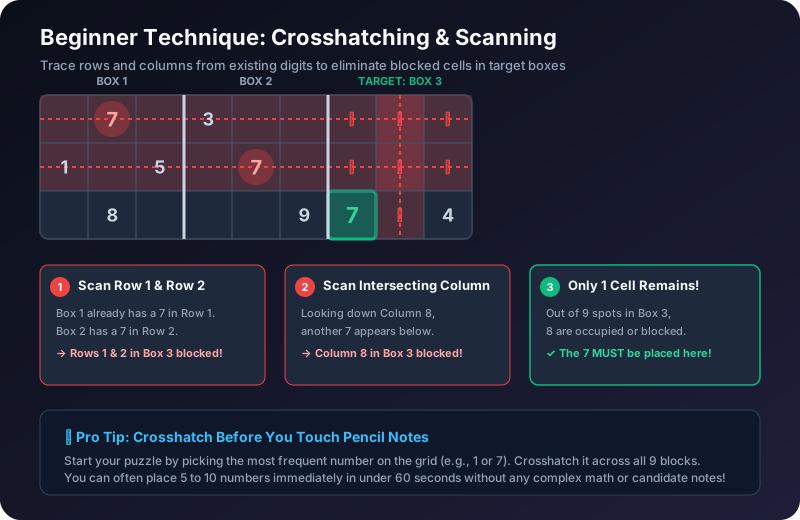
Crosshatching is the most powerful technique for beginner and intermediate solvers. Pick a digit that already appears multiple times on the board (for example, the digit 7).
Trace imaginary "laser lines" across rows and columns where that digit appears into an adjacent 3×3 block. Because that digit cannot repeat in those rows or columns, you can cross out (eliminate) all cells in the target block along those paths. Often, this leaves only one possible open cell in that 3×3 block for the digit to go.
Strategy 3: Pencil-In Notes (Candidate Marking)
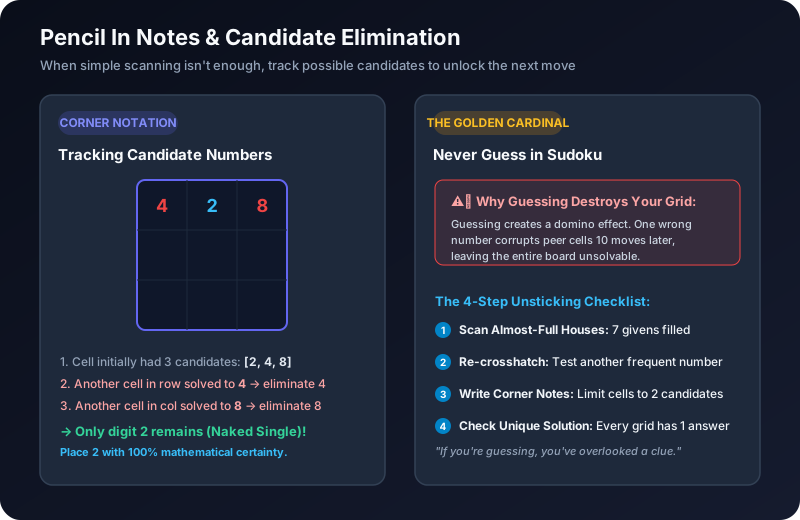
As puzzles move from Easy to Medium and Hard, simple scanning will no longer reveal instant single-cell placements. This is when you must use Pencil Notes (also known as candidate marking or corner notation).
In empty cells where you cannot yet commit a permanent number, jot down small candidate numbers representing digits that could logically fit. When another cell in the same row, column, or block is solved, erase or strike out that candidate from your notes. When a cell’s notes are pruned down to a single candidate, you have uncovered a Naked Single!
Strategy 4: The Golden Cardinal Rule: Never Guess!
If there is one lesson every Sudoku player must take to heart, it is this: NEVER GUESS.
Every properly constructed Sudoku puzzle has one and only one unique mathematical solution. There is always a logical path forward that does not require taking a 50/50 gamble.
Why guessing ruins games: If you guess a 5 in a cell that actually requires an 8, you might not notice an inconsistency until 20 moves later when two identical digits collide in a box. At that point, the entire board is poisoned, and untangling your mistake requires restarting the puzzle from scratch.
When you find yourself tempted to guess, pause and run through the four-step checklist:
- Re-scan all 9 rows for any house that now has 7 filled numbers.
- Switch your focus to a different number and run fresh crosshatching lines.
- Fill in pencil notes for cells that have only 2 possible candidates.
- Look for Naked Pairs or Hidden Pairs where two cells in a block share the exact same two candidates.
The 30-Second Video / Reel Breakdown
Prefer video walkthroughs? Here is our high-octane 30-second explanation designed for quick revision or social media video scripts:
[0:00 - 0:05] The Hook: "Think Sudoku requires advanced math? It actually requires zero arithmetic. Here is how to play and win in under 30 seconds."
[0:05 - 0:15] The Board: "The board is a 9×9 grid divided into nine 3×3 boxes. Your job is to fill every blank square using numbers 1 through 9."
[0:15 - 0:22] The One Rule: "There is only one golden rule: each number from 1 to 9 can appear only once in every row, once in every column, and once in every 3×3 square. No repeats!"
[0:22 - 0:28] Pro Tip: "Start by finding a row or box that's almost complete. Count what's missing, cross-reference the intersecting lines, and eliminate the impossible spots."
[0:28 - 0:30] Call to Action: "Grab an easy puzzle on NetSudoku and solve your very first grid today!"
How Instructional Guides Compare Across the Web
If you look at the top instructional guides on the web—from Sudoku Bliss, 247 Sudoku, Conceptis Puzzles, and Kristanix—most explain the fundamental rules well, but they force players to practice on outdated, ad-heavy platforms.
| Platform | Learning Experience | Hint Quality | Distractions & Limits |
|---|---|---|---|
| NetSudoku.com | Interactive diagrams, unlimited practice | Step-by-step educational explanations | Zero video ads · No 3-mistake limit |
| 247 Sudoku | Static text guides, basic grid | Simple digit reveal (no teaching) | Aggressive banner ads, battery drain |
| Sudoku.com / Apps | Standard beginner tutorial | Basic hints with coin/credit cost | 3-Mistake game over, unskippable video ads |
| Conceptis Puzzles | Great technique writeups | Static solver diagrams | Requires account login / registration |
Unlike mobile apps that hit you with a "Game Over" screen after making 3 simple mistakes while learning, NetSudoku believes in mistake-free exploration. You can enable or disable error highlighting, use automated candidate pruning, and learn advanced strategies like X-Wings and Swordfish at your own pace.
Frequently Asked Questions
Do I need to be good at math to play Sudoku? ▼
Not at all. Sudoku is purely a game of deductive logic and spatial elimination. The numbers 1 through 9 are simply distinctive symbols. No addition, subtraction, multiplication, or division is ever performed.
Can any number repeat on the board? ▼
Numbers repeat across different rows and different blocks, but they can never repeat within the same row, the same column, or the same 3×3 box. In a fully solved board, each digit from 1 to 9 appears exactly 9 times across all 81 cells.
What should I do if I get completely stuck? ▼
Check every house that has only 2 or 3 blank spaces remaining. If that doesn't yield a digit, write corner pencil notes for all empty cells in a single 3×3 block. Most "stuck" boards can be resolved simply by crosshatching a digit you haven't checked recently.
What is the difference between a Naked Single and a Hidden Single? ▼
A Naked Single occurs when a cell has 8 of the 9 digits already present in its intersecting row, column, and box, leaving only one possible candidate for that specific cell. A Hidden Single occurs when a candidate appears in multiple cells of a house, but for one particular digit, there is only one cell in the entire row, column, or block where that digit is legally allowed to sit.
Ready to Level Up Your Solving Skills?
Once you have mastered the basics of rows, columns, and crosshatching, explore our specialized guides:
Solve Your First Sudoku Board Now
Jump into a distraction-free, ad-free classic 9×9 puzzle. Practice crosshatching and candidate notes on desktop or mobile.